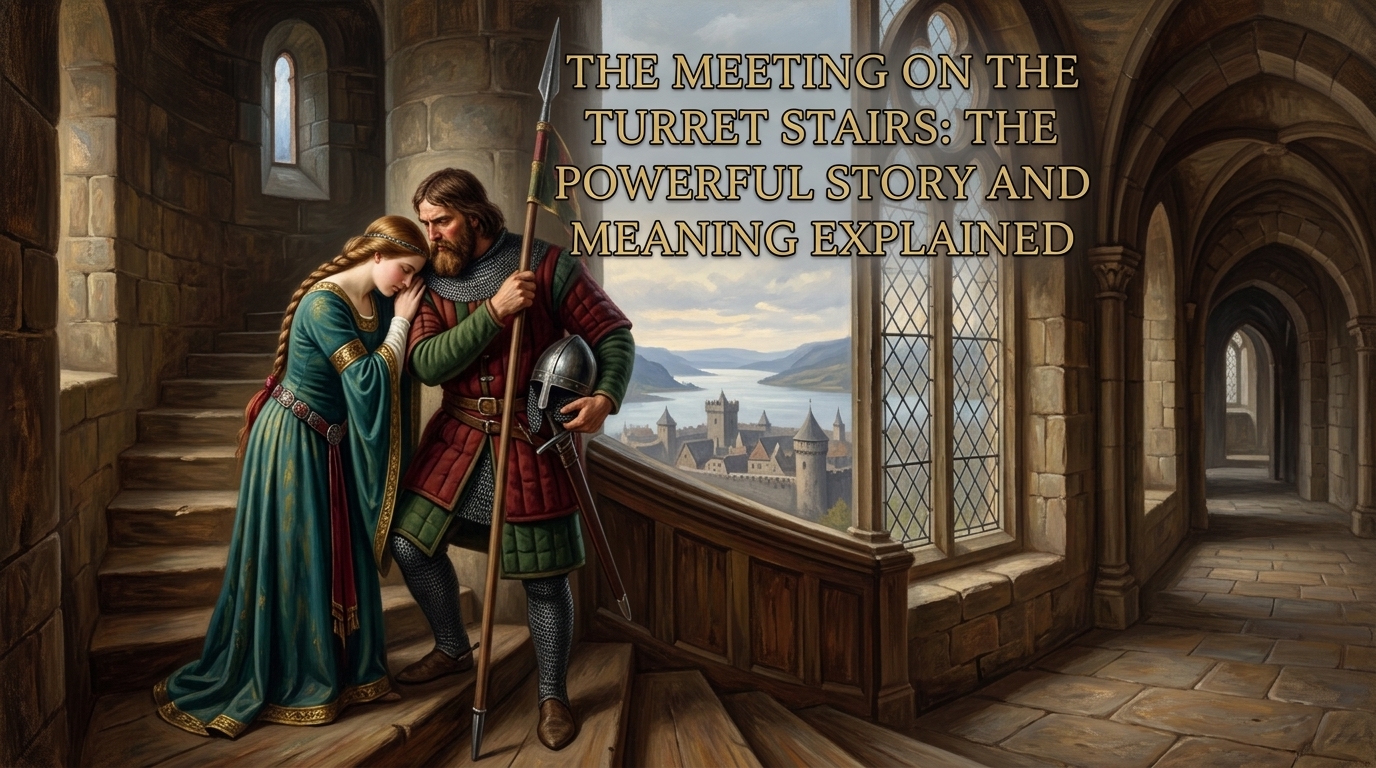
“The Meeting on the Turret Stairs” is one of the best known works by Irish artist Frederic William Burton. At first sight the 1864 watercolour seems to be showing only two young lovers sneaking off for a quiet moment on a staircase. It really only becomes profound when the story behind the scene is known.
The watercolour is of characters from a Danish ballad of medieval times.Hellelil is the king’s daughter.She falls in love with Hildebrand, her personal guard (he is said to also be prince of Engelland) but the king vehemently disapproves of the relationship, and eventually orders his sons to murder Hildebrand. The artist cleverly avoids any signs of violence, and depicts them, in such an evocative and intensely emotional scene, moments just before the massacre.
The painting is fascinating therefore, for reasons beyond just romance. The arrangement of the picture, the paint, the materials, the legend it depicts, the Victorian period, and its restraint are all factors in the great renown of this work.
What Is The Meeting on the Turret Stairs?
The Meeting on the Turret Stairs, more fully titled Hellelil and Hildebrand, the Meeting on the Turret Stairs, is a watercolour and gouache on paper created by Frederic William Burton in 1864. The painting measures around 95.5 x 60.8 cm and it belongs to the National Gallery of Ireland, with the collection number NGI.2358.
The painting is particularly interesting in that it remains one of the only works by Burton never to have been developed as an oil painting; throughout his career he remained a dedicated watercolourist, and no oil paintings by Burton are known to exist, according to the National Gallery of Ireland. However, the depth of colour in the Meeting on the Turret Stairs has sometimes given the impression of an oil painting to viewers.
This painting reflects Burton’s earlier development as a miniaturist. The detailed brushstrokes which characterize watercolour in this painting are derived from the detailed technique and layering necessary in miniaturist painting.
The Story Behind The Meeting on the Turret Stairs
Knowing the story to which the painting refers adds another layer to interpretation.
Burton took as his source a 14th-century Danish ballad relating the story of Hellelil and Hildebrand, providing the literary foundation for his 1864 composition. Burton’s friend, Whitley Stokes, translated the ballad which was published in Fraser’s Magazine in 1855. Burton later drew on the ballad for his composition of 1864.
Hellelil falls in love with her guard Hildebrand and she is refused permission by her father to see him, who orders his sons to put the young prince to death.
The original story is far more violent then suggested by the painting. Hildebrand kills all seven of Hellelil’s brothers who come to kill him, but at the princess’ request spares the youngest; Hildebrand later dies of his injuries according to the National Gallery of Ireland.
Knowing this provides a justification for the choice of scene, as Burton does not depict the violent culmination. Instead the two characters are pictured in their last meeting before the tragedy, creating an atmosphere focused on anticipation rather than action. The choice of this moment is a key decision in the painting.
Why Did Burton Show a Quiet Meeting Instead of the Violence?
A simpler illustration of the scene that the ballad used for the sword fight might have highlighted the action, the drama and the physical struggle. Burton chose rather less:
This is a tender, private meeting between the lovers who (presumably both) understand the situation they are in and their love for each other, and which they can do nothing about. The viewer (is likely to know or quickly find out that the two have an affair which will end in their death). That creates the drama and he does not have to explicitly paint them fighting.
In other words, the tragedy takes place outside the scene being pictured.
This makes the painting psychologically distinct to a usual historical battle painting. He encourages us to look not at which party is winning the fight but rather at the lovers, their close proximity together and at the poignancy and delicacy of the interaction.
The National Gallery of Ireland describes Burton’s work as picturing “a poignant and tender embrace rather than depicting the violent events taking place…in the ballad”.
The Meaning of the Turret Staircase
The staircase is not merely architectural decoration.
That the characters meet inside a turret staircase narrows their space. It may indicate their meeting is secreted or private as well as that the environment isolates them, helping with an atmosphere appropriate to clandestine romance. However it’s architecture also relates to their situation, limiting this access to between two of them and within the context of social, familial, political and religious constraints and control.
As an example the painting should thus perhaps, not only be interpreted simply as one of secret love although obviously it is.
For this is of course reflected and complemented within the setting. The lovers are with each other but the structure around them gives one little sense of escape.
How the Composition Creates Emotional Tension
One of the most effective characteristics of the painting is its concentration on the two figures.
Instead of including large amounts of figures and dynamic movement into his scene, Burton focuses on a few characters and turns it into an unforgettable encounter. He uses their bodies, costumes and drapery for pictorial design, whilst drawing upon their architectural surroundings to create the scene in this private dwelling. Such close focus on the scale of the encounter, is crucial to the painting, as the painting does not distance the observer from grand historical event but it places their attentions solely upon this one, significant encounter between two figures.
This juxtaposition then establishes a sense of pictorial peace in contrast to a tense drama where one cannot rely solely on what one observes, as a familiar to this particular story knows tension is to erupt and the scene is not going to stay as calm as it may initially appear.
This clash between the known narrative tension and the pictorial ease gives the painting a powerful impact.
Burton’s Use of Watercolor and Gouache
The technical execution of The Meeting on the Turret Stairs is another major reason the work is significant.
The National Gallery of Ireland states the medium is watercolour and gouache on paper. Burton applies the medium in the form of carefully blended washes and opaque sections resulting in a meticulously finished work. Watercolor can have connotations of ease and transparency but Burton shows that it can be highly controllable.
His work as a miniaturist would be of particular use when considering the level of fine detail and proportion that are important to this process and applying color accurately.
The layered nature of the watercolor application, as noted by the NGI, supports the idea that this skill was gained through his early career as a miniaturist. This needs to be taken into account when appreciating the work. This image should not be seen as merely easy to look at; considerable skill was involved in its execution.
What Makes the Colors Important?
Color plays a central role in the visual identity of the painting.
Such vibrant depth of colour is achieved despite Burton only working in watercolor and gouache. In The National Gallery of Ireland they say, ‘The hue of the color itself is rich, more than a comparable color would appear on an oil painting, though Burton himself was not an oil painter.’ This contrast matters enormously because, even though this is a sentimental tale, it contains very real tragedy as well as affection.
Here, color is what lures us into the scene, into identifying and believing in the lovers, and once we do… color is a beautiful lure from a future we know does not present peace between two young lovers.
That conflict between beauty and future disaster has long intrigued interpreters of this painting.’
The Role of Light in the Painting
Light also contributes to Burton’s carefully constructed composition.
The preliminary sketches have survived and are reproduced. As the National Gallery of Ireland points out, Burton worked through his ideas on these preparatory sketches before he was happy with the final watercolour, and in at least one sketch we see him identifying the direction he want the light to come from – it’s the turret window in the finished watercolour. This is helpful for knowing that the finished painting was consciously designed – the lighting is there, not simply an accidental element and it is used to guide our eyes around the painting; further undermining the notion of this painting being a spontaneous watercolor.
Frederic William Burton and His Artistic Background
Frederic William Burton (b. Ireland 1816) trained formally as a drawing master and initially achieved an early reputation as a miniature painter. George Petrie, as his peer, and latterly, became friend and mentor.
When Burton arrived in London he was soon earning money as a painter of portrait and subject works.
The Pre-Raphaelite movement influences on Burton are useful for interpreting this type of work through its emphasis on detailed craftsmanship and medieval themes. The Meeting on the Turret Stairs.
Burton’s career extended well beyond painting. In 1874, he became Director of the National Gallery in London, a position he held until his retirement in 1894. During his directorship, he played a significant role in acquiring important works for the collection.
This makes The Meeting on the Turret Stairs part of a broader artistic and institutional career rather than an isolated masterpiece.
The Pre-Raphaelite Connection
While not one of the original members of the Brotherhood, he was interested in their followers, and knew many of the broader artist community. As the National Gallery of Ireland says of the meeting: after arriving in London…burton was put in the company of a circle associated with the Pre-Raphaites…This beautifully achieved watercolour clearly echoes the atmosphere of such paintings. This is a point, too, that the connection is a strong one when you consider that at the level of theme-medievalism, romance and intense and complex finish and color-these are central concerns of Victorian painting in the middle part of the nineteenth century.
That said, that would be overstating it to label this painting in an uncomplicated way just a Pre-Raphaelite work: Burton’s work had a very specific path of its own, particularly through his watercolors, and as one of a training as miniaturist as well.
A better picture would say this work is in Victorian history about medieval things,literature andromancce and detail but still is thework of William Burton.
Why Is The Meeting on the Turret Stairs Famous?
The painting’s fame is due to a few reasons that contributed to its popularity.
First of all, the picture is attractive and full of emotional content. Second, the literary source of the painting adds an entirely new layer of meaning to the work. Third, Burton’s masterful technique gives this watercolor an amazing precision and intensity of expression.
Moreover, its place in the National Gallery of Ireland, where it was highlighted as one of the best works by the artist and was included in the main exhibits of the gallery, contributed to its popularity. The painting’s reputation has been further enhanced by the fact that in 2017-18 an entire exhibition was dedicated to Burton at the National Gallery of Ireland, which showcased more than seventy works. The story of this artist, his relationships with contemporaries, and his legacy were discussed, with The Meeting on the Turret Stairs playing a special role.
What Is the Main Theme of the Painting?
The most apparent theme of this work is the one of forbidden love, but the piece can also be interpreted in multiple other ways.
The relationship between the lovers depicted in the work goes beyond the limits imposed by the family and social order. The pair genuinely loves each other, but their fate is decided by external factors.
The painting examines the conflict between personal desires and social order.
Another apparent theme is the transience of happiness. By capturing the moment when the lovers are most blissful, Burton reminds the viewers that happiness is fragile and that it can be lost in an instant.
As such, he draws the viewers’ attention to the contrast between the image on the canvas and the tragic narrative behind it.
The very fact that the painting exists creates the sense of inevitability of the tragedy, thus provoking a certain response from the audience. The role of art is to make the viewers think, and in this respect, the painting accomplishes its goal.
Common Misunderstandings About the Painting
One of the most common misconceptions about the painting is that it depicts a happy romantic meeting without any tragic undertones. The very title might lead one to believe that, but in fact, the original ballad is deeply tragic, and Burton deliberately chose the moment right before the horrifying ending.
Another misconception is that this painting was done in oil. In fact, the National Gallery lists watercolour and gouache on paper as the painting media, and it is noted that no oil paintings by Burton have been discovered.
Finally, one might think that Burton made up the story depicted in his painting, but in fact, it was taken from a medieval Danish ballad, translated by his friend Whitley Stokes.
All of this context is vital to understanding the painting, as it is, in fact, a product of the Victorian era, a literary adaptation, and a masterful watercolour painting.
Where Can You See The Meeting on the Turret Stairs?
The original work belongs to the collection of the National Gallery of Ireland in Dublin, where visitors can find official information about the painting, its collection history, and current display arrangements.
Because of its conservation and display requirements, it is not necessarily available for unrestricted viewing at all times. The gallery currently lists limited viewing periods for the work in Room 20. Its visitor information states that the painting is displayed on Thursdays from 11:30 a.m. to 12:30 p.m. and Sundays from 2 p.m. to 3 p.m.
Anyone planning a visit should check the gallery’s current information before traveling because museum displays and viewing schedules can change.
Final Analysis: Why the Painting Still Matters
The Meeting on the Turret Stairs remains compelling because Burton transformed a violent medieval story into a quiet study of intimacy, beauty, and impending loss.
“Instead of the more obvious alternatives, the moment just before the fatal encounter, when the impending doom is evident to the audience, was captured.” In my opinion, such a choice of the author of the painting makes it more attractive and exciting. The observer of this picture becomes more involved in the plot of the work and thus becomes a full participant in the narrative. Although the image itself is quite serene, the very fact of knowledge of the outcome of the characters’ actions changes the perception of the picture as a whole.
Moreover, the author showed his outstanding mastery of watercolor and gouache, as well as his vast knowledge of the art of miniature painting. Thanks to the presented skills and competencies, as well as the study of the current literature and poetry of the era, he managed to create this outstanding work.
Thus, in my opinion, the meaning and deep meaning of the picture is hidden in the relationship between what can be seen and what is known. The author shows us a meeting of two lovers on the stairs, but at the same time, the viewer knows that this meeting will lead to the characters’ doom. This confrontation of two entirely different worlds – the beautiful image of love and the certainty of death as an inevitable outcome is reflected in this picture, attracting the attention of the viewer and drawing him into the plot.
8. Frequently Asked Questions
1. Who painted The Meeting on the Turret Stairs?
Frederic William Burton painted Hellelil and Hildebrand, the Meeting on the Turret Stairs in 1864. Burton was an Irish artist best known for his highly finished watercolours.
2. What is The Meeting on the Turret Stairs about?
The painting depicts Hellelil and Hildebrand, lovers from a medieval Danish ballad. Hellelil’s father disapproves of their relationship and orders his sons to kill Hildebrand. Burton shows the lovers during their final meeting before the tragic events unfold.
3. Is The Meeting on the Turret Stairs a Pre-Raphaelite painting?
Burton was not a founding member of the Pre-Raphaelite Brotherhood, but he encountered and admired the Pre-Raphaelite circle in London. The painting reflects some of the broader interests associated with nineteenth-century medievalism and highly detailed art.
4. What medium did Frederic William Burton use?
The work was made using watercolour and gouache on paper. Its rich colors can resemble the intensity of an oil painting, although Burton did not paint in oils.
5. Where is The Meeting on the Turret Stairs located?
The original is part of the collection of the National Gallery of Ireland in Dublin. The gallery currently lists limited viewing times for the work in Room 20.
6. What does the staircase symbolize in the painting?
The staircase can be interpreted as more than a setting. Its enclosed architecture reinforces the private nature of the meeting and can suggest the restrictions surrounding the lovers’ relationship. This is an interpretive reading rather than a documented statement of Burton’s specific intention.
7. Why is the painting considered important?
Its importance comes from the combination of a compelling medieval literary subject, Burton’s highly refined watercolour technique, its emotional restraint, and its place within the history of Irish and Victorian art. The National Gallery of Ireland considers it one of Burton’s significant works.
Conclusion
Your meeting notes are unclassified refers to information which, if disclosed, could not compromise national security; this is the correct response expected for the Cyber Awareness training question. While “unclassified” information does not necessarily compromise national security, there are still a set of handling requirements, which will differ based on what is documented within meeting notes. Knowing the definition of unclassified helps the misinterpretation that is usually made: unclassified equals unrestricted.