In high school geometry, learning to determine which pair of triangles can be proven congruent by SAS is one of the most fundamental skills you can master. The acronym SAS stands for Side-Angle-Side, a mathematical postulate asserting that if two sides and the included angle of one triangle are equal to two sides and the included angle of another triangle, then the two triangles are congruent. However, identifying which pair of triangles can be proven congruent by SAS requires far more than simply finding two equal sides and one equal angle—it demands a strict understanding of what makes an angle an included angle.
Students and educators frequently ask which pair of triangles can be proven congruent by SAS when analyzing complex geometric diagrams, coordinate proofs, and formal two-column geometric proofs. Misinterpreting the placement of the angle relative to the given sides is the single most common reason why students incorrectly identify which pair of triangles can be proven congruent by SAS.
This extensive guide provides a complete, mathematically rigorous exploration of triangle congruence. We will break down the criteria needed to prove which pair of triangles can be proven congruent by SAS, compare SAS against other congruence postulates like SSS, ASA, AAS, and HL, examine coordinate geometry applications, and work through step-by-step example proofs.
1. What Is the SAS (Side-Angle-Side) Congruence Postulate?
Before analyzing which pair of triangles can be proven congruent by SAS, we must clearly define the SAS Postulate and its core mathematical conditions.
┌──────────────────────────────────────────────────────────────────────────┐
│ THE SAS CONGRUENCE POSTULATE │
├──────────────────────────────────────────────────────────────────────────┤
│ │
│ Triangle 1: Side A ───────── Included Angle 𝜃 ───────── Side B │
│ │ │ │
│ ▼ MUST MATCH EXACTLY IN POSITION ▼ │
│ Triangle 2: Side A’ ──────── Included Angle 𝜃’ ──────── Side B’ │
│ │
└──────────────────────────────────────────────────────────────────────────┘
Official Definition
The Side-Angle-Side (SAS) Congruence Postulate explains the conditions for triangle congruence:
If two sides and the included angle of one triangle are congruent to the corresponding two sides and included angle of another triangle, the two triangles are congruent by the SAS Congruence Theorem.
In formal geometric notation, given $\triangle ABC$ and $\triangle DEF$:
$$\text{If } \overline{AB} \cong \overline{DE}, \quad \angle B \cong \angle E, \quad \text{and } \overline{BC} \cong \overline{EF}$$
$$\text{Then } \triangle ABC \cong \triangle DEF$$
The Crucial Concept: The “Included Angle”
To correctly identify which pair of triangles can be proven congruent by SAS, you must understand the exact definition of an included angle.
An included angle is the angle formed directly between two given sides. It is physically “trapped” or “sandwiched” by those two sides.
- In $\triangle ABC$, the angle included between side $AB$ and side $BC$ is $\angle B$.
- The angle included between side $AC$ and side $BC$ is $\angle C$.
- The angle included between side $AB$ and side $AC$ is $\angle A$.
If the given congruent angle is NOT located between the two congruent sides, you have an SSA (Side-Side-Angle) configuration. In Euclidean geometry, SSA does not guarantee congruence (except in the special right-triangle case of Hypotenuse-Leg). Therefore, an SSA configuration can never answer which pair of triangles can be proven congruent by SAS.
2. Essential Conditions to Prove Triangles Congruent by SAS
To evaluate a given diagram or problem set and decide which pair of triangles can be proven congruent by SAS, test the configuration against the following three mandatory criteria:
┌──────────────────────────────────────────────────────────────────────────┐
│ THE THREE CHECKPOINTS FOR SAS CONGRUENCE │
├───────────────────┬──────────────────────────────────────────────────────┤
│ CHECKPOINT │ REQUIREMENT │
├───────────────────┼──────────────────────────────────────────────────────┤
│ 1. First Side │ Exactly one pair of corresponding sides are congruent│
│ 2. Included Angle │ The angle BETWEEN the two sides is congruent │
│ 3. Second Side │ Exactly a second pair of adjacent sides are congruent│
└───────────────────┴──────────────────────────────────────────────────────┘
- Two Pairs of Corresponding Congruent Sides: You must have rigid proof or given markings showing that two distinct side lengths in the first triangle equal two corresponding side lengths in the second triangle.
- One Pair of Corresponding Congruent Included Angles: The congruent angles must lie directly at the vertex where the two congruent sides intersect.
- Correct Sequence Order: As you trace around the perimeter of the triangle, the parts must follow the sequential order: Side $\rightarrow$ Angle $\rightarrow$ Side.
If any of these three conditions fail, you cannot declare which pair of triangles can be proven congruent by SAS.
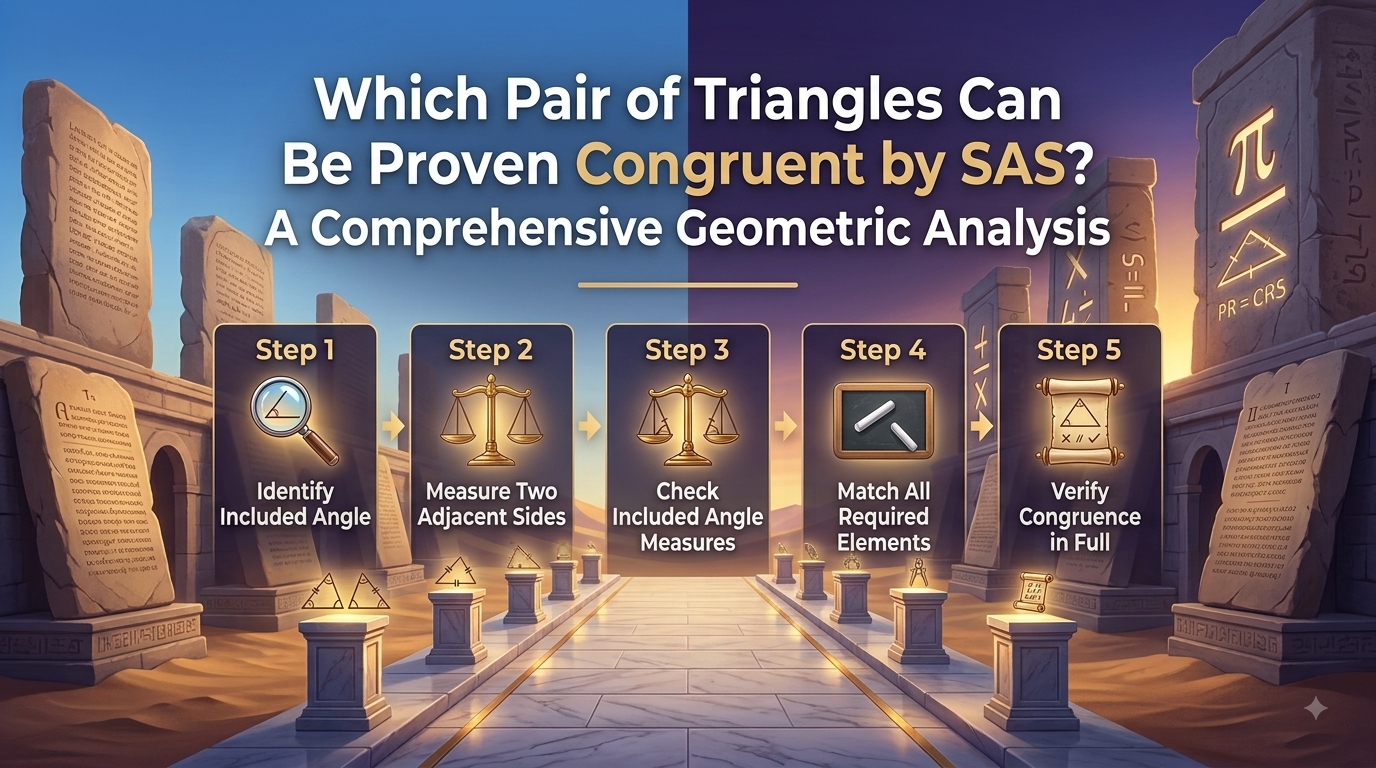
3. How to Identify Which Pair of Triangles Can Be Proven Congruent by SAS
When looking at multiple test questions or visual pairs of triangles, follow this systematic elimination checklist to determine which pair of triangles can be proven congruent by SAS.
1.Step 1: Identify Given Congruent Sides:Markings Analysis.
Examine the diagram or problem statement for hash marks (tick marks) indicating equal segment lengths. Count the pairs of congruent sides. You need exactly two pairs.
2.Step 2: Locate the Given Congruent Angle:Angle Location.
Identify which angle possesses an arc mark or degree measurement showing equality. Verify its exact position relative to the two marked sides.
3.Step 3: Confirm the Angle is Included:Verification.
Check if the marked angle is formed by the intersection of the two marked sides. If the arc mark is at a vertex touch point between the two tick-marked sides, SAS applies.
4.Step 4: Reject Invalid Configurations (SSA / AAA):Elimination.
If the arc mark is located at an angle outside the two sides (SSA), or if all three angles are marked without two sides (AAA), eliminate the pair. The correct choice for which pair of triangles can be proven congruent by SAS must strictly be SAS.
4. Visual Examples: Valid vs. Invalid SAS Configurations
To solidify your ability to recognize which pair of triangles can be proven congruent by SAS, let us analyze four distinct geometric pairs.
┌──────────────────────────────────────────────────────────────────────────┐
│ VISUAL PAIR COMPARISON MATRIX │
├───────────────────────┬─────────────────────────┬────────────────────────┤
│ PAIR CONFIGURATION │ ANGLE POSITION │ CAN BE PROVEN BY SAS? │
├───────────────────────┼─────────────────────────┼────────────────────────┤
│ Pair 1: Side-Angle-Side│ Between marked sides │ YES (Valid SAS) │
│ Pair 2: Side-Side-Angle│ Outside marked sides │ NO (Invalid SSA) │
│ Pair 3: Angle-Side-Ang│ Between marked angles │ NO (Valid ASA, not SAS)│
│ Pair 4: Side-Side-Side │ No angle marked │ NO (Valid SSS, not SAS)│
└───────────────────────┴─────────────────────────┴────────────────────────┘
Pair 1: The Classic SAS Pair (Valid)
- Triangle 1 ($\triangle ABC$): Side $AB = 5\text{ cm}$, Included Angle $\angle B = 45^\circ$, Side $BC = 8\text{ cm}$.
- Triangle 2 ($\triangle DEF$): Side $DE = 5\text{ cm}$, Included Angle $\angle E = 45^\circ$, Side $EF = 8\text{ cm}$.
- Analysis: Here, $\angle B$ lies directly between $AB$ and $BC$, and $\angle E$ lies directly between $DE$ and $EF$. Therefore, Pair 1 represents which pair of triangles can be proven congruent by SAS.
Pair 2: The SSA Trap Pair (Invalid for SAS)
- Triangle 1 ($\triangle PQR$): Side $PQ = 6\text{ cm}$, Side $QR = 9\text{ cm}$, Non-included Angle $\angle P = 30^\circ$.
- Triangle 2 ($\triangle XYZ$): Side $XY = 6\text{ cm}$, Side $YZ = 9\text{ cm}$, Non-included Angle $\angle X = 30^\circ$.
- Analysis: Although there are two congruent sides and one congruent angle, the angle ($\angle P$ / $\angle X$) is not between the marked sides ($PQ$ and $QR$). This is an SSA pattern, which does not prove congruence. This pair is not which pair of triangles can be proven congruent by SAS.
Pair 3: Shared Side (Reflexive Property) Pair (Valid)
Consider a parallelogram $ABCD$ divided into two triangles ($\triangle ABD$ and $\triangle CDB$) by diagonal $BD$:
- Given: $AB \parallel CD$ and $AB \cong CD$.
- Shared element: Diagonal $BD \cong BD$ by the Reflexive Property of Congruence.
- Angle relationship: Alternate interior angles $\angle ABD \cong \angle CDB$ because $AB \parallel CD$.
- Analysis: In $\triangle ABD$, we have side $AB$, included angle $\angle ABD$, and side $BD$. In $\triangle CDB$, we have side $CD$, included angle $\angle CDB$, and side $BD$. Because the congruent angles are sandwiched between the given and shared sides, this is an excellent example of which pair of triangles can be proven congruent by SAS.
5. Formal Two-Column Geometric Proofs Using SAS
When completing mathematical proofs, determining which pair of triangles can be proven congruent by SAS requires translating visual evidence into logical statements and geometric theorems.
Example Proof: Vertical Angles and Midpoints
Given:
- Segment $AC$ and segment $BD$ bisect each other at point $E$.
Prove:
$$\triangle ABE \cong \triangle CDE$$
┌──────────────────────────────────────────────────────────────────────────┐
│ DIAGRAM SCHEMATIC FOR MIDPOINT PROOF │
├──────────────────────────────────────────────────────────────────────────┤
│ │
│ A ───────────────────────── E ───────────────────────── C │
│ ╱ ╲ │
│ ╱ * ╲ (Vertical Angles at E) │
│ ╱ ╲ │
│ D ───────────────────── E ───────────────────────────── B │
│ │
└──────────────────────────────────────────────────────────────────────────┘
Formal Two-Column Proof
| Step | Statements | Reasons |
| 1 | Segment $AC$ and segment $BD$ bisect each other at $E$ | Given |
| 2 | $\overline{AE} \cong \overline{CE}$ | Definition of Segment Bisector |
| 3 | $\overline{BE} \cong \overline{DE}$ | Definition of Segment Bisector |
| 4 | $\angle ABE$ and $\angle CDE$ share vertical angle $\angle AEB \cong \angle CED$ | Vertical Angles Theorem (Vertical angles are always congruent) |
| 5 | $\triangle ABE \cong \triangle CDE$ | SAS Congruence Postulate (Sides $AE, BE$ and included angle $\angle AEB$) |
In this formal deduction, Step 5 conclusively answers which pair of triangles can be proven congruent by SAS.
6. SAS in Coordinate Geometry: How Distance & Slope Formulas Prove Triangle Congruence
In coordinate geometry, questions asking which pair of triangles can be proven congruent by SAS do not always provide explicit angle marks or side lengths. Instead, you must calculate side lengths using the Distance Formula and prove angle equality using perpendicular slopes or shared axes.
The Coordinate Tools
- Distance Formula:
$$d = \sqrt{(x_2 – x_1)^2 + (y_2 – y_1)^2}$$
Used to prove that two corresponding side lengths are equal ($\overline{AB} \cong \overline{DE}$). - Slope Formula:
$$m = \frac{y_2 – y_1}{x_2 – x_1}$$
Used to determine angle relationships in geometry. If two lines have slopes $m_1$ and $m_2$ such that $m_1 \cdot m_2 = -1$, the lines intersect at right angles ($90^\circ$). Right angles are always congruent.
Coordinate Example Problem
Let $\triangle ABC$ have vertices at $A(0, 4)$, $B(0, 0)$, and $C(3, 0)$.
Let $\triangle DEF$ have vertices at $D(5, 0)$, $E(5, 4)$, and $F(8, 4)$.
We want to test if this is a valid candidate for which pair of triangles can be proven congruent by SAS.
┌──────────────────────────────────────────────────────────────────────────┐
│ COORDINATE GEOMETRY COMPARISON │
├───────────────────────┬─────────────────────────┬────────────────────────┤
│ MEASUREMENT │ TRIANGLE ABC │ TRIANGLE DEF │
├───────────────────────┼─────────────────────────┼────────────────────────┤
│ Vertical Side Length | $AB = |4 – 0| = 4$ │ $DE = |4 – 0| = 4$ │
│ Horizontal Side Length| $BC = |3 – 0| = 3$ │ $EF = |8 – 5| = 3$ │
│ Intersecting Angle | $\angle B = 90^\circ$ │ $\angle E = 90^\circ$ │
│ | (Y-axis meets X-axis) | (Vertical meets Horiz.)│
└───────────────────────┴─────────────────────────┴────────────────────────┘
Calculations:
- Side 1: $AB = 4$ and $DE = 4 \implies \overline{AB} \cong \overline{DE}$.
- Side 2: $BC = 3$ and $EF = 3 \implies \overline{BC} \cong \overline{EF}$.
- Included Angle: Side $AB$ is vertical and side $BC$ is horizontal, meeting at origin $B(0,0)$ to form a right angle ($\angle B = 90^\circ$). Similarly, $DE$ is vertical and $EF$ is horizontal, meeting at $E(5,4)$ to form a right angle ($\angle E = 90^\circ$).
- Since all right angles are congruent, $\angle B \cong \angle E$.
Because $\angle B$ is included between $AB$ and $BC$, and $\angle E$ is included between $DE$ and $EF$, $\triangle ABC \cong \triangle DEF$ by SAS. This confirms coordinate pairs can easily demonstrate which pair of triangles can be proven congruent by SAS.
7. SAS vs. Other Congruence Postulates (SSS, ASA, AAS, HL)
To avoid confusing SAS with other geometric criteria when deciding which pair of triangles can be proven congruent by SAS, compare the key congruence methods side-by-side.
| Congruence Method | Required Given Parts | Angle Location Relative to Sides | Can it prove SAS? |
| SAS (Side-Angle-Side) | 2 Sides + 1 Angle | Angle MUST be included between the 2 sides | N/A (This is SAS) |
| SSS (Side-Side-Side) | 3 Sides | No angles required | No (Proves congruence by SSS) |
| ASA (Angle-Side-Angle) | 2 Angles + 1 Side | Side MUST be included between the 2 angles | No (Proves congruence by ASA) |
| AAS (Angle-Angle-Side) | 2 Angles + 1 Side | Side is non-included (opposite an angle) | No (Proves congruence by AAS) |
| HL (Hypotenuse-Leg) | Right angle + Hypotenuse + 1 Leg | Special case of right triangles | No (Special right triangle theorem) |
| SSA (Side-Side-Angle) | 2 Sides + 1 Angle | Angle is non-included | INVALID (Does not guarantee congruence) |
Understanding these distinctions ensures that when faced with multiple-choice questions regarding which pair of triangles can be proven congruent by SAS, you do not mistakenly select an ASA or SSS configuration.
8. Common Pitfalls and How to Avoid Them
When evaluating geometry exam questions about which pair of triangles can be proven congruent by SAS, students frequently fall into predictable traps. Here is how to avoid them:
Pitfall 1: Assuming Pictures Are Drawn to Scale
Never rely purely on visual appearance. A diagram might look like two sides and an included angle match, but unless tick marks, arc marks, parallel line arrows, or given text explicitly state the geometric relationships, you cannot assume congruence.
Pitfall 2: Confusing SSA with SAS
This is The most widespread error when solving geometry problems involving SAS. Always trace the triangle with your pencil:
- If your pencil moves from Side $\rightarrow$ Angle $\rightarrow$ Side continuously, it is SAS.
- If your pencil skips an angle and moves Side $\rightarrow$ Side $\rightarrow$ Angle, it is SSA, which is mathematically invalid for general triangle congruence.
Pitfall 3: Overlooking Implicit Geometric Properties
In many advanced proof problems asking which pair of triangles can be proven congruent by SAS, not all equal parts are explicitly labeled with tick marks. You are expected to infer congruent parts using fundamental theorems:
- Reflexive Property: A shared side is congruent to itself ($BD \cong BD$).
- Vertical Angles Theorem: Intersecting lines form congruent opposite angles ($\angle 1 \cong \angle 2$).
- Alternate Interior Angles: Parallel lines cut by a transversal form equal interior angles.
- Midpoint Definition: A midpoint divides a line segment into two equal halves.
By unlocking these implicit relationships, you can frequently find the hidden included angle or second side needed to establish which pair of triangles can be proven congruent by SAS.
Practical Practice Questions & Solutions
Question 1
In $\triangle GHI$, $GH = 7$, $HI = 10$, and $\angle H = 50^\circ$. In $\triangle JKL$, $JK = 7$, $KL = 10$, and $\angle K = 50^\circ$. Can these triangles be proven congruent by SAS?
- Solution: Yes. In $\triangle GHI$, $\angle H$ is the angle included between sides $GH$ and $HI$. In $\triangle JKL$, $\angle K$ is the angle included between sides $JK$ and $KL$. Since two sides and their included angles are equal ($7 = 7$, $50^\circ = 50^\circ$, $10 = 10$), $\triangle GHI \cong \triangle JKL$ by SAS. This is a definitive example of which pair of triangles can be proven congruent by SAS.
Question 2
In $\triangle MNO$, $MN = 4$, $NO = 6$, and $\angle M = 40^\circ$. In $\triangle PQR$, $PQ = 4$, $QR = 6$, and $\angle P = 40^\circ$. Can these triangles be proven congruent by SAS?
- Solution: No. In $\triangle MNO$, the sides given are $MN$ and $NO$. The included angle between $MN$ and $NO$ is $\angle N$, not $\angle M$. Because $\angle M$ is opposite side $NO$, this is an SSA arrangement. Therefore, this pair cannot be proven congruent by SAS.
Summary of SAS Triangle Congruence
To quickly summarize how to answer which pair of triangles can be proven congruent by SAS:
- Verify that both triangles have two pairs of congruent sides.
- Verify that both triangles have one pair of congruent angles.
- Confirm that the congruent angles are strictly included (sandwiched directly between the two known sides).
- Watch for implicit properties like shared sides (Reflexive Property) or vertical angles to supply missing information.
By mastering the position of the included angle, you can effortlessly identify which pair of triangles can be proven congruent by SAS in any geometric scenario.