Repetitive manual work can create production bottlenecks, inconsistent cycle times and ergonomic strain, particularly when the same movement is repeated hundreds or thousands of times per shift. Robotic integration can help by transferring suitable tasks to programmable equipment that performs a defined sequence consistently. The key is selecting the right task rather than assuming every manual process should be automated.
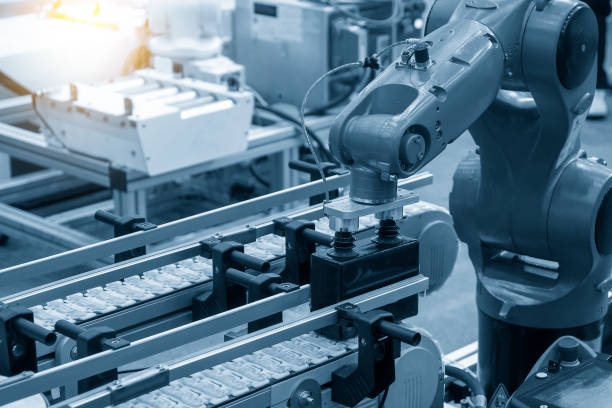
Pick-and-place work is a common example. A robot can move products between conveyors, fixtures, pallets or packaging stations when the parts, positions and timing can be defined reliably. Similar opportunities can exist in machine tending, palletising, welding, assembly and inspection. The suitability of each task depends on payload, reach, speed, product variation and the environment around the machine.
Automation can improve repeatability because a robot follows programmed positions and sequences rather than changing its technique throughout a shift. That consistency can support product quality and predictable cycle times. However, the robot still depends on reliable part presentation, tooling, sensors and control logic. If products arrive randomly or fixtures are inconsistent, the integration may need vision systems or additional handling equipment.
Safety must be designed into the complete cell. Fencing, interlocks, scanners, emergency stops and safe operating modes may be required depending on the application and risk assessment. Collaborative robots can provide different options in some situations, but the word collaborative does not remove the need for a proper assessment of tooling, speed, payload and interaction with people.
Robotic integration also changes the work performed by employees. Operators may move from repetitive handling toward loading materials, monitoring the process, completing quality checks, changing formats or responding to faults. Maintenance and engineering teams may need additional skills in robot recovery, programming and diagnostics. Planning training as part of the project helps the new system become practical rather than intimidating.
Production flexibility should be considered early. A cell that handles only one product may be simple, while a line with many variants may need recipe management, adjustable tooling, vision guidance or quick-change fixtures. The most useful system balances automation with the level of variation the business actually experiences instead of overcomplicating the design.
Integration with existing machinery is often where the real engineering work occurs. Robots need signals from PLCs, conveyors, sensors and safety systems so every part of the cell knows when it is safe and appropriate to move. Clear handshaking between equipment reduces collisions, waiting and ambiguous states during faults or restarts.
Before investing, businesses should define what repetitive work is costing them in cycle time, labour demand, quality variation, injury risk or production capacity. Those measures provide a practical basis for evaluating the project. Robotic integration is most successful when it solves a specific operational problem and can be maintained by the people who will support it after commissioning.
Once the cell is running, performance should be reviewed with operators and maintenance staff. Small changes to gripper timing, part presentation, alarm messages or recovery procedures can make a large difference to day-to-day usability. Continuous improvement helps ensure the robot remains an effective production tool rather than a fixed system that becomes harder to use as products and processes change.
Reliable automation depends on more than the initial installation. Electrical design, control logic, safety, maintenance and operator needs all influence long-term performance. AKA Electrical & Automation works across industrial electrical and automation systems, helping businesses integrate and improve equipment with the production environment and operational requirements in mind.