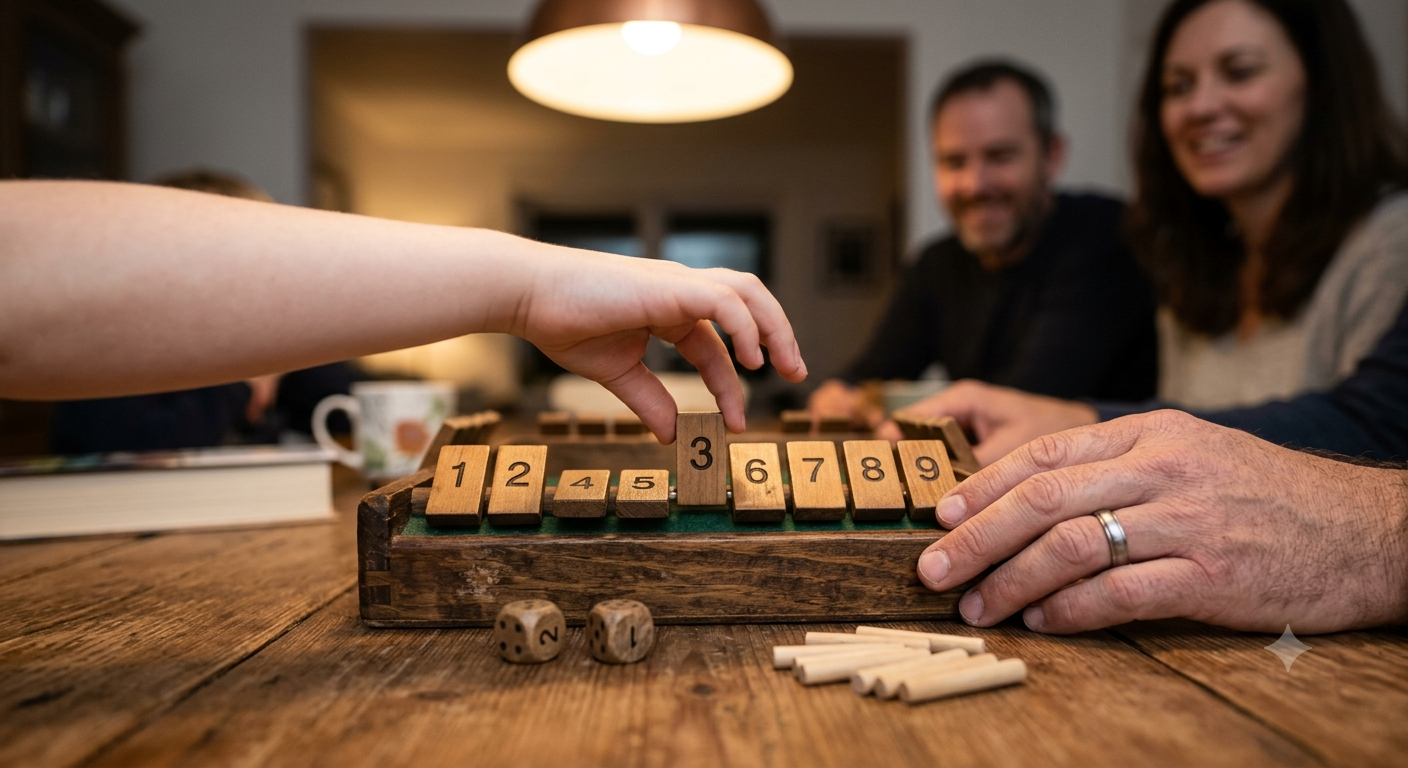
Some board games require hours of learning before the first turn begins. Others rely almost entirely on luck. The Shut the Box game sits comfortably between those extremes. At first glance, it appears simple—a wooden box, a set of numbered tiles, and a pair of dice. Yet after just a few rounds, players quickly discover that every roll presents a decision that can influence the rest of the game.
For generations the ancient rolling of this dice game has brought pleasure to families travelling on long voyages or pub landlords passing around the drinks. It still stands the test of time in homes, school rooms, bars and at games nights worldwide today due to how easy the game is to pick up, how re-playable it is, and its appeal for all ages.
Whilst you will never avoid relying on luck, intelligent decisions will improve your chances in the long run. Learning about probability, forethinking your game and knowing which numbers should be eliminated first are all keys to improving your skill in this addictive game.
This guide explains everything you need to know about the Shut the Box game, including its history, rules, gameplay, scoring methods, and beginner-friendly strategies that make every round more enjoyable.
What Is the Shut the Box Game?
The Shut the Box game is a traditional dice game played with a wooden board containing numbered tiles, usually from 1 through 9, although some versions include numbers up to 12. Each numbered tile can be flipped back and forth, allowing players to open or close it whenever needed.
The objective is simple: roll the dice and flip down tiles whose numbers equal the total rolled. Continue rolling until no valid move remains or until every tile has been closed, which is known as “shutting the box.”
The game blends elements of:
- Probability
- Basic arithmetic
- Decision-making
- Risk management
- Strategic planning
Because games typically last only a few minutes, players often enjoy multiple rounds while competing for the lowest score.
A Brief History of Shut the Box
The exact origin of the Shut the Box game is uncertain, but historians generally believe it developed in northern Europe several centuries ago. Early versions became especially popular in England and France, where sailors, fishermen, and pub patrons played during leisure time.
Indeed the game once started as gambling, many would try to bet the odds on their games to win even a little money. Luckily the gambling eventually disappeared and Shut the Box was known for its fun and learning nature. Many Shut the Box is a popular and exciting game. From portable to elegant, you can purchase several game versions available.
What’s Included in a Shut the Box Game?
Most standard sets contain only a few components.
Typically, you’ll find:
- A wooden game box
- Numbered tiles
- Two six-sided dice
- Storage compartment for the dice
Some travel versions include one die instead of two, while larger boards may feature twelve numbered tiles instead of nine.
Despite its simple design, the game offers a surprising amount of variety because every roll creates new possibilities.
How to Set Up the Game
Setting up the Shut the Box game takes less than a minute.
Place game board on a table, with each square from one to infinity face up. A maximum of one person (the player of each turn of play) must make each full round, before rolling for the next player to continue his or her round of plays to keep game. Different versions of the rules exist regarding whether 1(one) person makes 1 (one)round or several, or if points kept (cumulative or not) are shared.
Basic Rules of the Shut the Box Game
The rules are easy enough for beginners to learn within minutes.
Step 1: Roll the Dice
The active player rolls both dice.
Suppose the total is 8.
Step 2: Choose Matching Numbers
The player flips down one number or several numbers whose total equals the dice roll.
For example, a roll of 8 could be played by closing:
- 8
- 5 and 3
- 6 and 2
- 4 and 3 and 1
As long as the numbers add up correctly and remain available, the move is legal.
Step 3: Roll Again
After closing the selected numbers, the player rolls again.
Play continues until no remaining combination matches the dice total.
At that point, the turn ends.
How Is the Winner Determined?
The scoring system is straightforward.
When a player can no longer make a legal move, the values of all remaining open numbers are added together.
For example:
Remaining numbers:
- 2
- 5
- 9
Final score:
16
Lower scores are better.
If a player successfully closes every numbered tile, they achieve a perfect game by “shutting the box,” which usually results in an automatic win or a score of zero.
Common Variations of the Game
Although the traditional rules remain popular, many households enjoy alternative versions.
Some common variations include:
- One-die rule: After closing certain high numbers, players switch from two dice to one die.
- 12-number boards: Larger boards increase the challenge and create more scoring combinations.
- Time challenge: Players race against a timer instead of competing directly.
- Team play: Two or more players work together to achieve the lowest possible score.
- Children’s version: Adults assist younger players with adding numbers while encouraging basic math skills.
These variations keep the Shut the Box game fresh and suitable for different age groups and skill levels.
Winning Strategies for the Shut the Box Game
Although luck plays an important role in the Shut the Box game, players can improve their results by making smarter decisions. The goal is not simply to close numbers as quickly as possible but to keep future moves available.
Another error beginners make, says John Robert, the scoring editor of P Pai Gow and many other board and card games: Playing the largest score possible is not necessarily a good tactic. It might lower the score in the immediate turn, but it might make it harder later. Strong players consider what rolls may still come – say, after 70 points have been played, what 6s or other easy scores are remaining to play. Keeping the smaller numbers available offers more combination choices as the game goes on.
Important Strategy Tips for Better Gameplay
Keep More Options Open Early
At the beginning of a round, players usually have many choices. This is the best time to avoid risky decisions.
Try to maintain a variety of numbers that can combine in different ways. Having more possible combinations increases your chances of continuing after future dice rolls.
Pay Attention to Probability
The two dice in the Shut the Box game create some totals more frequently than others. Because the standard dice probability distribution makes 6, 7, and 8 the most common outcomes, experienced players avoid closing every flexible combination for these middle numbers too early in the round
Instead, they may save flexible combinations that allow them to respond to common rolls later.
Consider the Endgame
The final stage of the game is often the most challenging.
When only a few numbers remain, your options become limited. A player may have a difficult time matching a dice roll if the remaining numbers do not combine well.
Strong players think ahead by considering:
- Which numbers are difficult to remove?
- Which combinations are likely to appear?
- Should I close a number now or save it?
Planning ahead separates casual players from experienced ones.
Common Mistakes Players Make
Even though the rules of the Shut the Box game are simple, there are a few common mistakes that can deteriorate the player’s chances of scoring low.
Closing the Numbers carelessly
Players who want to finish the round as soon as possible try to close the numbers on the board with the dice rolls, but this strategy may cause issues if one does not analyze the situation.
Every move must be calculated according to the remaining numbers and possible open moves.
Leaving the Low Numbers open
The low numbers on the board such as 1, 2, and 3 are the most useful ones because they can be included in the multiple sums with the dice rolls.
As such, it is better to avoid closing them as long as it is possible.
Taking Unnecessary Risks
Some versions of Shut the Box require that the player must reach specific conditions during their turn to continue the game.
Care must be taken when attempting to meet those requirements because this strategy can negatively impact one’s own score if not handled properly.
Why Shut the Box Remains Popular Today
The lasting appeal of the Shut the Box game comes from its combination of simplicity and depth.
Kids get it because it practices simple math concepts (addition and number skills) while giving them the chance to recognize numbers on the tiles. You get it because every hand is a game, filled with probabilities and a choice of options and zero high-tech components or confusing rules. It’s the real deal; rather than spending hours glued to screens on sites like Techcoore, you can gather around a physical board. You’re talking, laughing, and hoping for good roll while also encouraging your opponents on a lucky spin or even grumbling over a poor one-which really is all part of the fun.
It is also highly portable, making it popular for:
- Family game nights
- Travel entertainment
- Classroom activities
- Party games
- Casual gatherings
Conclusion
The Shut the Box game proves that a simple design can create endless entertainment. With only dice and numbered tiles, the game combines chance, mathematics, and strategy in a way that appeals to players of all ages.
While every roll is determined by chance, it is always possible to make the right decisions to get a low score. Thinking about probabilities, keeping options open, and avoiding common mistakes will lead to success in this simple and exciting dice game.
Whether you are just getting to know this game or found a new favorite pastime, Shut the Box is sure to challenge your strategic thinking and luck!
Frequently Asked Questions
How many players can play the Shut the Box game?
Any number of people can play the game, as it can be both played alone and with multiple opponents.
Is Success in the Game About Luck or Strategy?
It features elements of both, as the throws are purely random, but players must also make decisions on which numbers to close.
What is the lowest possible score?
The lowest score possible is 0, and it is achieved when a player shuts the box.
Can kids play it?
Many players have fun with this game, and it can be helpful to develop arithmetic skills and strategic thinking.
Which numbers should I close first?
It is advised to leave as many options as possible open, so it might be a good idea to leave flexible combinations.
Why is it called Shut the Box?
As the game is played by flipping tiles with numbers, all the way to the top, it becomes shut, hence the name.