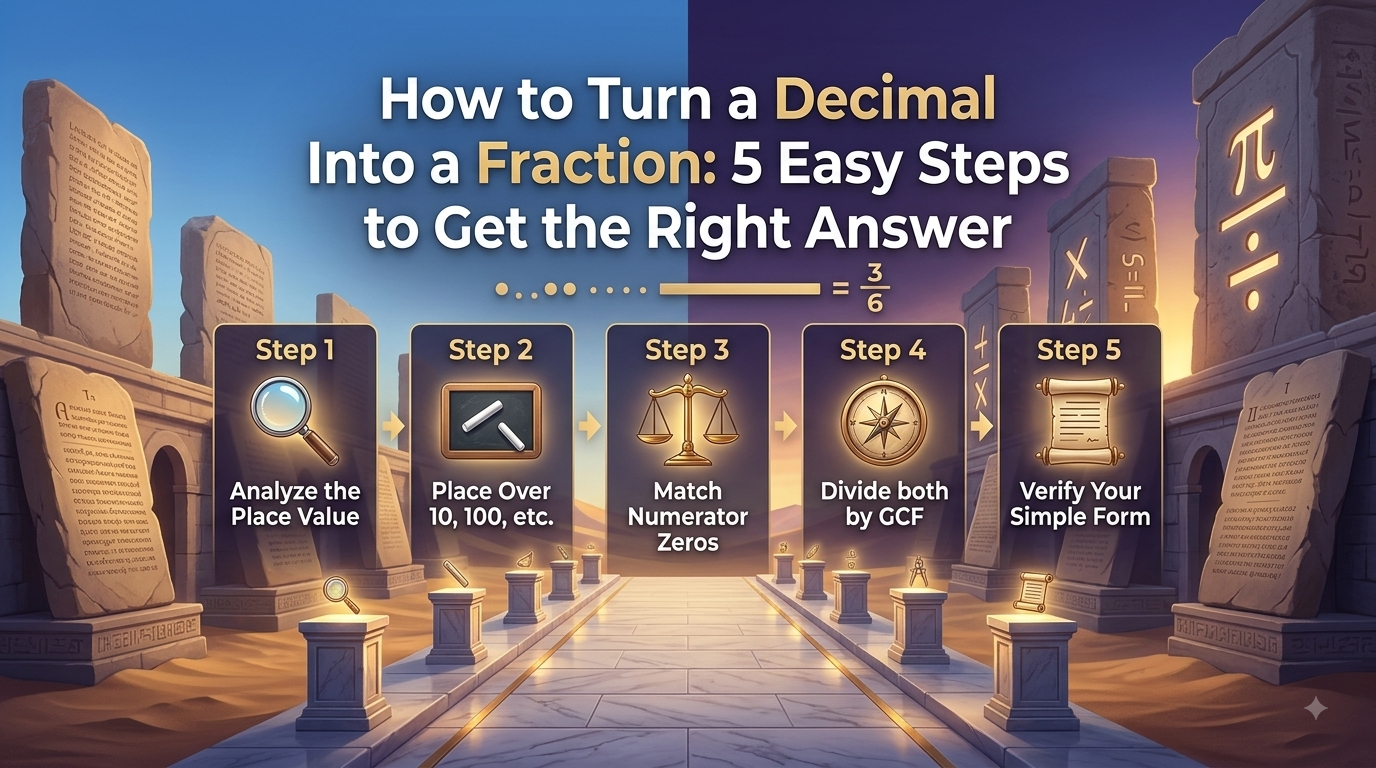
Knowing how to turn a decimal into a fraction is a useful math skill because fractions and decimals are simply two different ways of representing the same value. A decimal such as 0.5 can be written as 1/2, while 0.75 can be expressed as 3/4.
It then boils down to a more or less fairly simply method for whether we have a terminating or a repeating decimal. For terminating decimals, it’s essentially to write your decimal as a fraction over an appropriate power of 10, and then reduce it. For repeating decimals, there’s a small different procedure involved to come at it algebraically.
The following has details from the start to finish including numbers with decimals at the whole numbers, in minus format, also including repeateddecimals and typical faults when writing these.
Understanding How to Turn a Decimal Into a Fraction
Decimals – place value- you can determine what is the original denominator by looking where the decimal number last ended. For you that would just get the 0 in the answer.
For example:
- 0.4 has one digit after the decimal, so its initial denominator is 10.
- 0.27 has two decimal places, so its initial denominator is 100.
- 0.625 has three decimal places, so its initial denominator is 1,000.
Therefore:
0.4 = 4/10
0.27 = 27/100
0.625 = 625/1,000
The resulting fractions are not always in simplest form The very last step that one has is to simplify by finding the greatest common divisor of the numerator and denominator. The rule itself becomes clear. Namely: based on the quantity of the digits which follow the decimal, establish the first order of magnitude 10 in the denominator.
How the Conversion Works
For a terminating decimal, you can follow three basic ideas:
- Remove the decimal point from the number.
- Put the resulting whole number over 10, 100, 1,000, or another appropriate power of 10.
- Simplify the fraction.
Suppose you want to convert 0.36.
There are two digits after the decimal point, so use 100:
0.36 = 36/100
Both 36 and 100 are divisible by 4:
36 ÷ 4 = 9
100 ÷ 4 = 25
Therefore:
0.36 = 9/25
The decimal and fraction have exactly the same value. Simplifying simply gives you a cleaner representation.
Step-by-Step Guide for Terminating Decimals
Step 1: Write Down the Decimal
Start with the original value and identify whether it ends.
For example:
0.875
Because the digits stop after 875, this is a terminating decimal.
Step 2: Count the Decimal Places
The number has three digits after the decimal point.
That means the denominator will initially be 1,000.
Step 3: Remove the Decimal Point
Move the decimal point out of the number without changing the sequence of digits:
0.875 → 875
Place that number over 1,000:
875/1,000
Step 4: Simplify
Find the greatest common factor of 875 and 1,000. In this case, it is 125.
Divide both parts:
875 ÷ 125 = 7
1,000 ÷ 125 = 8
So:
0.875 = 7/8
This four-step approach works for practically any terminating decimal.
Converting Decimals With Whole Numbers
A decimal does not have to be less than 1. The same method works with mixed values.
Consider:
2.5
There is one digit after the decimal point, so begin with:
25/10
Simplify by dividing both numbers by 5:
25 ÷ 5 = 5
10 ÷ 5 = 2
Therefore:
2.5 = 5/2
You can also express this as the mixed number 2 1/2.
For a larger example:
7.25 = 725/100
Divide numerator and denominator by 25:
725 ÷ 25 = 29
100 ÷ 25 = 4
Therefore:
7.25 = 29/4
The important point is that the whole-number portion does not require a separate conversion. Simply remove the decimal point and use the correct power of 10.
Converting Negative Decimals
Negative decimals follow exactly the same process. The negative sign remains attached to the resulting fraction.
For example:
-0.75 = -75/100
Simplifying by 25 gives:
-3/4
So:
-0.75 = -3/4
The negative sign can technically be placed before the fraction, in the numerator, or in the denominator, but the conventional form is to keep it in front or with the numerator.
Repeating Decimals Require a Different Method
A repeating decimal does not terminate. Instead, one or more digits continue indefinitely.
Examples include:
0.333…
and
0.727272…
The usual power-of-10 method alone does not produce a complete fraction because there is no final decimal place.
For a repeating decimal such as 0.333…, use algebraic cancellation.
Let:
x = 0.333…
Multiply both sides by 10:
10x = 3.333…
Now subtract the original equation:
10x – x = 3.333… – 0.333…
This leaves:
9x = 3
Divide by 9:
x = 1/3
Therefore:
0.333… = 1/3
For a repeating sequence with more than one digit, multiply by the appropriate power of 10. For example, a two-digit repeating pattern requires multiplication by 100 before subtraction.
This method is more advanced than the terminating-decimal approach, but the underlying idea is to make the repeating portions cancel.
Common Examples at a Glance
| Decimal | Initial Fraction | Simplified Fraction |
| 0.5 | 5/10 | 1/2 |
| 0.25 | 25/100 | 1/4 |
| 0.6 | 6/10 | 3/5 |
| 0.75 | 75/100 | 3/4 |
| 0.8 | 8/10 | 4/5 |
| 0.125 | 125/1,000 | 1/8 |
| 1.5 | 15/10 | 3/2 |
| 2.25 | 225/100 | 9/4 |
| 0.875 | 875/1,000 | 7/8 |
The table illustrates an important pattern: the first fraction is often larger than necessary, while simplification produces the standard reduced form.
Common Mistakes and Misunderstandings
Using the Wrong Denominator
The denominator must correspond to the number of decimal places.
For 0.45, the correct initial denominator is 100, not 10.
0.45 = 45/100
Forgetting to Simplify
Writing 50/100 for 0.5 is mathematically correct, but it is usually preferable to reduce it:
50/100 = 1/2
A fraction is considered simplified when the numerator and denominator have no common factor greater than 1.
Counting Zeros Instead of Decimal Places
Consider 0.007.
There are three digits after the decimal point, so the denominator is 1,000:
0.007 = 7/1,000
The two zeros after the decimal point are part of the place-value structure and should not be ignored.
Treating Repeating Decimals Like Terminating Decimals
A value such as 0.666… does not have a final decimal position. Writing 666/1,000 would represent 0.666 exactly, not the infinite repeating value.
Repeating decimals need the algebraic cancellation method.
Real-World Considerations
Knowing how to switch back and forth between decimals and fractions can be exceptionally handy if a math problem is a mix of numeric types. Like if the measurement provided was 0.75 inches and then part of the equation somehow refers to quarters. Transforming 0.75 to 3/4 clearly clarifies just the relationship.
That helps when dealing with rations, units, recipes, construction and structural designs, likelihood as well as probability, and much of algebra.
Decimals help the use of the calculator along with units whereas fractional amounts sometimes makes it clear exactly the association involving items or ideas.
Another useful reason to convert is accuracy. A fraction can represent an exact value that may become less convenient when rounded into a decimal.
For instance, 1/3 produces 0.333… rather than a terminating decimal. Rounding it to 0.33 changes the exact value slightly.
Important Tips for Faster Conversion
A few habits make decimal-to-fraction problems much easier:
- Count decimal places first. This immediately tells you the denominator.
- Remove the decimal point carefully. Keep every digit, including zeros that occur between the decimal point and significant digits.
- Reduce the fraction. Look for a common factor shared by both numbers.
- Check your answer. Divide the numerator by the denominator and see whether you return to the original decimal.
- Separate terminating and repeating decimals. The two types use different conversion techniques.
- Keep negative signs consistent. The sign belongs to the entire fraction.
For mental math, it also helps to recognize familiar equivalents such as 0.5 = 1/2, 0.25 = 1/4, 0.75 = 3/4, and 0.2 = 1/5.
Frequently Asked Questions
What is the simplest way to convert a decimal into a fraction?
The easiest way is to take a terminating decimal and remove the decimal point, placing the digits over the appropriate power of 10, and then simplifying the fraction.
How do you convert 0.75 into a fraction?
A terminating decimal such as this one, 0.75, has two decimal places. So, write 75 over 100 and then simplify by dividing by 25. So, 75/25=3 and 100/25=4. Therefore, 3/4 is the fraction.
How do you convert 0.125 as a fraction?
Write 0.125 as 125/1000 since there are three decimal places. Then, simplify by dividing by 125 and you will get 1/8.
Can every decimal be expressed as a fraction?
Every decimal, whether terminating or recurring can be expressed as a fraction. Decimals that are neither recurring nor terminating cannot be expressed as a simple fraction.
How can you check that your decimal is correct?
You could divide the numerator by the denominator to ensure that the decimal is equivalent to the fraction.
Final Takeaway
Students can learn the most efficient way to convert a terminating decimal to a fraction by focusing on the place value of the decimal. A terminating decimal can be converted to a fraction by removing the decimal point, placing the number in the numerator over a denominator of the same power of 10 place value. Then, you can simplify the fraction.
Using the place value to write fractions is especially simple with terminating decimals. For instance, 0.625 is read as six hundred twenty-five thousandths. So, we write 625/1000 and then simplify to 5/8. Converting whole numbers and negative decimals to a fraction works the same way, but with repeating decimals, you need to use algebra to solve for x. The most critical step in converting decimals to fractions is to check and ensure that your answer is correct. The best way is to divide the numerator by the denominator and see if the decimal is equivalent.
Converting decimals to fractions is a vital skill that helps students gain confidence with fractions and decimal place values. With understanding of decimal place value, simplifying decimals, particularly terminating decimals, to fractions is much simpler than most people realize. A decimal can be converted to a fraction quickly by using the decimal place value as the denominator in the fraction, and then simplifying the resulting fraction. After which, it is essential to check the work by multiplying the denominator by the decimal to check if the result is equal to the numerator. This way decimals become more accessible, which makes arithmetic operations with decimals and fractions more fun.