The history of atomic theory is filled with discoveries that gradually changed our understanding of matter. Today, students learn about atoms as having a tiny nucleus surrounded by electrons, but scientists did not always have this picture. One of the earliest attempts to explain atomic structure was the Plum Pudding Model, proposed in the early 20th century. Although it was later replaced by more accurate theories, the Plum Pudding Model played a crucial role in the development of modern physics and chemistry.
If you’ve searched for Plum Pudding Model, you may be studying atomic theory for school, preparing for an examination, or simply curious about how scientists once imagined atoms. Understanding this model helps explain not only the evolution of scientific thinking but also why experimentation is essential to scientific progress.
In this detailed guide, you’ll learn what the Plum Pudding Model is, who proposed it, how it works, why it was accepted, why it was eventually rejected, and how it influenced the development of modern atomic theory.
What Is the Plum Pudding Model?
The Plum Pudding Model is an early model of atomic structure proposed by the English physicist J. J. Thomson in 1904, often referred to historically as the Thomson atomic mode lin classical physics literature.
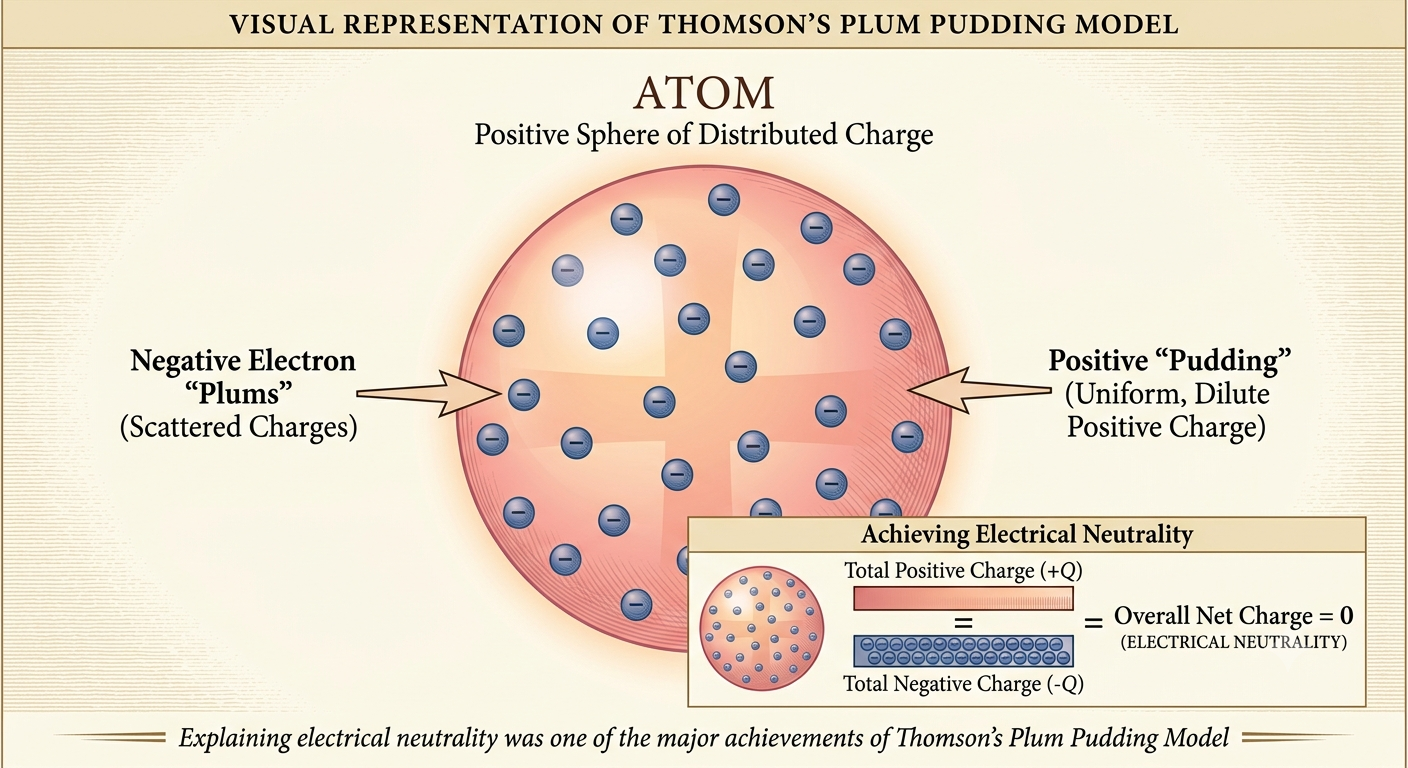
According to this model, an atom consists of a positively charged sphere with negatively charged electrons embedded throughout it. Thomson compared the arrangement to plums scattered throughout a traditional English plum pudding, which inspired the model’s memorable name.
In simple terms:
- The positive charge filled the entire atom.
- Electrons were distributed throughout this positively charged material.
- There was no central nucleus.
- The positive and negative charges balanced each other, making the atom electrically neutral.
Although modern science has shown that atoms have a very different structure, the Plum Pudding Model represented a major step forward because it was the first widely accepted model to include electrons.
Who Proposed the Plum Pudding Model?
The Plum Pudding Model was proposed by Sir J. J. Thomson, a British physicist.
Thomson is best known for discovering the electron in 1897 through his experiments with cathode rays.
Before this discovery, many scientists believed that atoms were indivisible, as suggested by earlier theories such as John Dalton’s atomic model.
Once Thomson demonstrated that electrons existed, scientists realized atoms contained smaller particles.
This raised an important question:
If atoms contain negatively charged electrons, where does the positive charge exist?
The Plum Pudding Model was Thomson’s answer.
Why Was the Plum Pudding Model Developed?
The discovery of the electron created a challenge for existing atomic theories.
Atoms were known to be electrically neutral.
If electrons carried negative charges, there had to be an equal amount of positive charge somewhere inside the atom.
Since no nucleus had yet been discovered, Thomson proposed that positive charge was spread evenly throughout the entire atom.
The electrons were thought to be embedded inside this positive material, much like raisins or plums inside a dessert.
At the time, this explanation successfully accounted for the known evidence.
Why Is It Called the Plum Pudding Model?
The name comes from a popular British dessert called plum pudding.
Traditional plum pudding contains pieces of dried fruit distributed throughout a dense pudding.
Thomson imagined the atom in a similar way:
- The pudding represented positive charge.
- The plums represented electrons.
Although people in many countries today may not be familiar with the dessert, the comparison became widely used in science textbooks and remains one of the best-known historical atomic models.
Structure of the Plum Pudding Model
According to the Plum Pudding Model, the atom had several important features.
These included:
- A uniform sphere of positive charge.
- Negatively charged electrons embedded throughout the sphere.
- No central nucleus.
- Even distribution of positive charge.
- Overall electrical neutrality.
Unlike the modern atomic model, there was no empty space inside the atom.
Instead, the entire atom was thought to be filled with positive material.
Main Features of the Plum Pudding Model
Several characteristics define the Plum Pudding Model.
1. Electrons Exist Inside the Atom
Thomson’s greatest contribution was recognizing that atoms contained electrons.
This represented a major advancement over earlier atomic theories.
2. Positive Charge Is Spread Throughout
Instead of being concentrated in one location, positive charge filled the entire atom.
3. No Atomic Nucleus
The model did not include a nucleus because one had not yet been discovered.
4. Neutral Atom
The positive and negative charges balanced perfectly, making the atom electrically neutral.
How the Plum Pudding Model Explained Atomic Neutrality
One important achievement of the Plum Pudding Model was explaining why atoms normally have no overall electrical charge.
Because:
- Positive charge filled the atom.
- Negative electrons were embedded within it.
The total positive and negative charges canceled each other.
Although the explanation was later shown to be incorrect, it represented a logical solution based on the evidence available at the time.
Advantages of the Plum Pudding Model
Despite eventually being replaced, the Plum Pudding Model had several important strengths.
First, it acknowledged the existence of electrons, which had only recently been discovered.
Second, it provided one of the first attempts to explain how positive and negative charges could coexist within an atom.
Third, it inspired further experiments that eventually led to the discovery of the atomic nucleus.
Without Thomson’s model, later scientists may not have had the foundation needed to improve atomic theory.
Why Scientists Initially Accepted It
Today the Plum Pudding Model seems obviously incorrect, but early scientists had good reasons for accepting it.
At the time:
- Electrons had been discovered.
- No nucleus had yet been observed.
- Experimental technology was limited.
- There was no evidence contradicting Thomson’s proposal.
Science advances by building upon existing knowledge, and Thomson’s model represented the best explanation available in 1904.
Rutherford’s Gold Foil Experiment: The Turning Point
For a few years, the Plum Pudding Model was widely accepted because it explained the presence of electrons inside the atom. However, scientific theories must always be tested through experiments. Around 1909, physicist Ernest Rutherford, together with his colleagues Hans Geiger and Ernest Marsden, performed an experiment that completely changed the understanding of atomic structure.
In this famous experiment, a thin sheet of gold foil was bombarded with tiny, positively charged particles called alpha particles. According to the Plum Pudding Model, the positive charge was spread evenly throughout the atom. Scientists expected the alpha particles to pass through the foil with only slight deflections because there was no dense center to block them.
The actual results were surprising:
- The majority of alpha particles traveled straight through the gold foil with little or no deflection.
- Some were deflected at large angles.
- A very small number bounced almost directly back toward the source.
The strange findings proved to the scientists that it cannot be a solid ball of positive charge where all electrons are planted. Instead, most of the atom contained largely empty space and the most of the positivity and mass was contained in the very centre in what the scientists decided to name a nucleus.
With these findings a new and innovative perception of the structure of an atom took place with the end of the reign of the plum-pudding model.
Why the Plum Pudding Model Was Rejected
In the eyes of the scientific world, theories exist only if they align with the result of an experiment. When Rutherford’s experiment delivered experimental data that did not agree with Thomson’s theory, then the Plum Pudding Model lost its validity.
Several major problems became clear:
It Could Not Explain Large Deflections
This is when he decided the most of the atom is empty. With a smooth distribution of positive charge throughout the atom there would have only been a very slight deflection and there will not have been a significant amount of deflections as in this gold foil experiment.
It Did Not Include a Nucleus
Modern atomic theory recognizes the nucleus as the center of the atom, containing protons and, later discovered, neutrons. The Plum Pudding Model had no nucleus at all.
It Misrepresented Atomic Structure
Instead of being completely packed with stuff atomss are mostly empty space with tiny nucleus in the centre. While the original model had to be disarded the research set scientist off looking deeper into how things work by further researching structure of the atom.
Why Rutherford’s Nuclear Model Replaced the Plum Pudding Model
Following the gold foil experiment, Rutherford proposed a new model of the atom.
According to his nuclear model:
- Nearly all the mass is concentrated in a tiny nucleus.
- The nucleus contains positive charge.
- Electrons exist outside the nucleus.
- Most of the atom consists of empty space.
This explanation successfully accounted for the results of the gold foil experiment and laid the foundation for later atomic models developed by scientists such as Niels Bohr and Erwin Schrödinger.
Plum Pudding Model vs. the Modern Atomic Model: Key Differences
Understanding how science has evolved becomes easier when comparing the Plum Pudding Model with today’s accepted model of the atom.
| Feature | Plum Pudding Model | Modern Atomic Model |
| Positive charge | Spread throughout the atom | Concentrated in the nucleus |
| Electrons | Embedded in positive material | Move around the nucleus in regions called orbitals |
| Nucleus | Not included | Present at the center of the atom |
| Empty space | None | Most of the atom is empty space |
| Scientific status | Historical model | Current accepted theory |
This comparison highlights how scientific understanding improves as new evidence becomes available.
Advantages of the Plum Pudding Model
Although later proven incorrect, the Plum Pudding Model made several valuable contributions to science.
It Recognized That Atoms Contain Smaller Particles
Earlier theories treated atoms as indivisible. Thomson’s work showed that atoms contain electrons, fundamentally changing scientific thinking.
It Explained Electrical Neutrality
The model provided one of the earliest explanations for why atoms are electrically neutral by balancing positive and negative charges.
It Encouraged Further Research
Every scientific model helps generate new questions. The Plum Pudding Model inspired experiments that eventually led to the discovery of the atomic nucleus.
It Advanced Atomic Theory
Rather than being the final answer, the model served as an important stepping stone toward the modern understanding of atoms.
Limitations of the Plum Pudding Model
Despite its historical importance, the Plum Pudding Model had several significant weaknesses.
It could not explain:
- The existence of the atomic nucleus.
- Results from the gold foil experiment.
- Why electrons remain arranged in stable patterns.
- The mostly empty nature of atoms.
- Later discoveries involving protons and neutrons.
As more evidence became available, these shortcomings made it clear that a new atomic model was necessary.
Why the Plum Pudding Model Is Still Taught Today
Some students wonder why they still learn about a disproven model, but as explored across Tech Coore, understanding foundational concepts is key to learning how modern science and technology evolve.
Studying the Plum Pudding Model helps students understand:
- How scientific ideas develop.
- Why experiments are essential.
- How evidence can overturn accepted theories.
- The importance of questioning existing knowledge.
- The history of modern chemistry and physics.
Learning about incorrect theories is just as valuable as learning about correct ones because it shows how scientific knowledge evolves over time.
Common Misconceptions About the Plum Pudding Model
Myth 1: Scientists still believe the Plum Pudding Model.
False. The Plum Pudding Model is a historical theory that has been replaced by more accurate models supported by experimental evidence.
Myth 2: The model described atoms exactly as they are.
No. It represented the best explanation available in 1904 but was later shown to be incomplete.
Myth 3: Thomson’s work was a failure.
Not at all. Discovering the electron was one of the greatest achievements in physics. Although his atomic model was later replaced, his discoveries transformed modern science.
Myth 4: The Plum Pudding Model had no scientific value.
On the contrary, it played a crucial role in advancing atomic theory and inspired experiments that led to major discoveries.
Importance of the Plum Pudding Model in Science
The significance of the Plum Pudding Model extends far beyond whether it was correct.
It demonstrated that:
- Scientific theories are based on evidence.
- New discoveries often require older ideas to be revised.
- Even incorrect models can contribute to scientific progress.
- Science advances through observation, experimentation, and critical thinking.
Without Thomson’s contributions, later scientists might not have developed the nuclear model as quickly.
Conclusion
The Plum Pudding Model, proposed by J. J. Thomson after the discovery of the electron, marks a significant step forward in understanding atomic structure. As the first successful and well-regarded atomic model, it was the first time an attempt was made to explain the structure of an atom in terms of particles smaller than atoms yet carrying a charge. In offering a model of the atom as a uniformly positively charged mass dotted with negative electrons, the Plum Pudding Model was logically consistent with the information available at the time.
The experiments of Rutherford, known as the gold foil experiment, ultimately demonstrated that the atom has a relatively massive nucleus at its center and is mostly empty space, disproving the model as the definitive structure. Nevertheless, because the Plum Pudding Model was the first model successfully proposed in accordance with the findings known before the early part of the 20th century, and because of its subsequent impact on future models, the Plum Pudding Model continues to be taught today and is part of what makes the development of scientific models so interesting.
Frequently Asked Questions
1. What is the Plum Pudding Model?
J. J. Thomson proposed the Plum Pudding Model in 1904 as one of the earliest models of atomic structure. It describes the atom as a positively charged sphere with negatively charged electrons embedded throughout it.
2. Why is it called the Plum Pudding Model?
The name comes from a traditional British dessert called plum pudding, in which pieces of fruit are scattered throughout the pudding. Thomson compared the electrons to the fruit and the positive charge to the pudding.
3. Who proposed the Plum Pudding Model?
The model was proposed by the British physicist J. J. Thomson, who also discovered the electron.
4. Why was the Plum Pudding Model rejected?
It was rejected because Rutherford’s gold foil experiment showed that atoms contain a small, dense nucleus rather than a uniform sphere of positive charge.
5. What replaced the Plum Pudding Model?
Rutherford’s nuclear model replaced it and later served as the basis for more advanced atomic models developed by Niels Bohr and quantum physicists.
6. Was the Plum Pudding Model completely wrong?
While it did not correctly describe atomic structure, it correctly recognized that atoms contain electrons and played an important role in the development of atomic theory.
7. Why is the Plum Pudding Model important today?
It illustrates how scientific theories evolve through experimentation and evidence, making it an important part of the history of science.
8. Is the Plum Pudding Model still taught in schools?
Yes. It is commonly taught to help students understand the progression of atomic theory and the scientific method.